
What Pillar 3 is
Basel capital rules stand on three pillars: minimum capital (Pillar 1), the supervisor’s own review (Pillar 2), and market discipline (Pillar 3). Pillar 3 makes banks publish key data on their capital, risks and risk management, in fixed templates, so investors and the public can compare them.
In the EU the templates are set by Commission Implementing Regulation (EU) 2024/3172, which applies from 1 January 2025. The EBA turns them into reporting modules, so the same data can travel as a file:
The EBA Pillar 3 data hub
The Pillar 3 data hub (P3DH) is the EBA’s single access point where the Pillar 3 disclosures of EU and EEA banks can be found and compared. Since reference date June 2025, institutions other than small and non-complex institutions send their disclosures straight to the EBA, through its EUCLID channel, not through their national supervisor. The numbers go in xBRL-CSV and the narrative in a PDF report.
The data is due on the same day the bank publishes its financial statements for the period, or as soon as possible after (Article 4(1) of the EBA’s final draft standards on the hub). For small and non-complex institutions, the EBA publishes Pillar 3 data from what they already report to their supervisor. Each institution also files one contact persons template, X 01.00, by 31 January each year.
- Returns that accept the format
How often banks disclose
It depends on the bank and the template, under Articles 433a (large institutions), 433b (small and non-complex) and 433c (other) of the CRR. The EBA’s frequency file gives examples: EU KM1 key metrics is quarterly for large listed institutions, semi-annual for large non-listed and other listed ones, and annual for small and non-complex institutions and other non-listed ones. Most credit risk templates are semi-annual for large listed institutions.
Pillar 3 ESG: the disclosures and the ESG risk data
Pillar 3 ESG means two related things. The first is the ESGDIS module: large listed institutions disclose their ESG risks twice a year. Release 4.4 brings a new version from reference date 31 December 2026, with 8 templates, for the amended ESG disclosure requirements.
The second is the ESG risk data collection under EBA Decision EBA/DC/498. National supervisors pass the quantitative ESG data that large listed banks already disclose to the EBA, semi-annually, as at 30 June and 31 December, by 31 December and 30 June respectively. Banks send it to their supervisor in the format the supervisor sets, in templates D 01.00 to D 10.00. Germany’s Bundesbank takes it through PRISMA and France’s ACPR through OneGate, both in xBRL-CSV.
The EBA calls this collection an interim solution until the data is in supervisory reporting. On 6 November 2026 it said its final reporting package reduces ESG-related reporting and defers ESG reporting until December 2028.
Outside Europe: Brazil, Chile and Nigeria
In Brazil, institutions in segments S1 to S4 publish a Pillar 3 report on their own websites under Resolução BCB 54. Key tables such as KM1, OV1, LIQ1 and LIQ2 are quarterly, due within 60 days of each quarter end and within 90 days of 31 December.
In Chile, every bank, and every branch of a foreign bank, publishes a quarterly Pillar 3 document under chapter 21-20 of the CMF’s rules, no more than 15 days after its statement of financial position. In Nigeria, banks publish Pillar 3 disclosures twice a year and send them to the Central Bank of Nigeria, within 30 days of publishing their financial statements.
What Line4 does for Pillar 3 reporting
Line4 is Pillar 3 reporting software for the supervisor. Banks send their Pillar 3 and ESG files straight from their own systems, by portal, API or MCP, in xBRL-CSV or XBRL-XML. Line4 checks every file against the EBA’s rules the moment it arrives, and keeps each accepted return as data a supervisor can compare across banks and periods, the way the Pillar 3 data hub compares disclosures.
For banks, Line4 Check runs all 3,889 of EBA's active ESG checks on the ESG risk data return in the browser before it is filed, free. The file never leaves the bank’s computer.
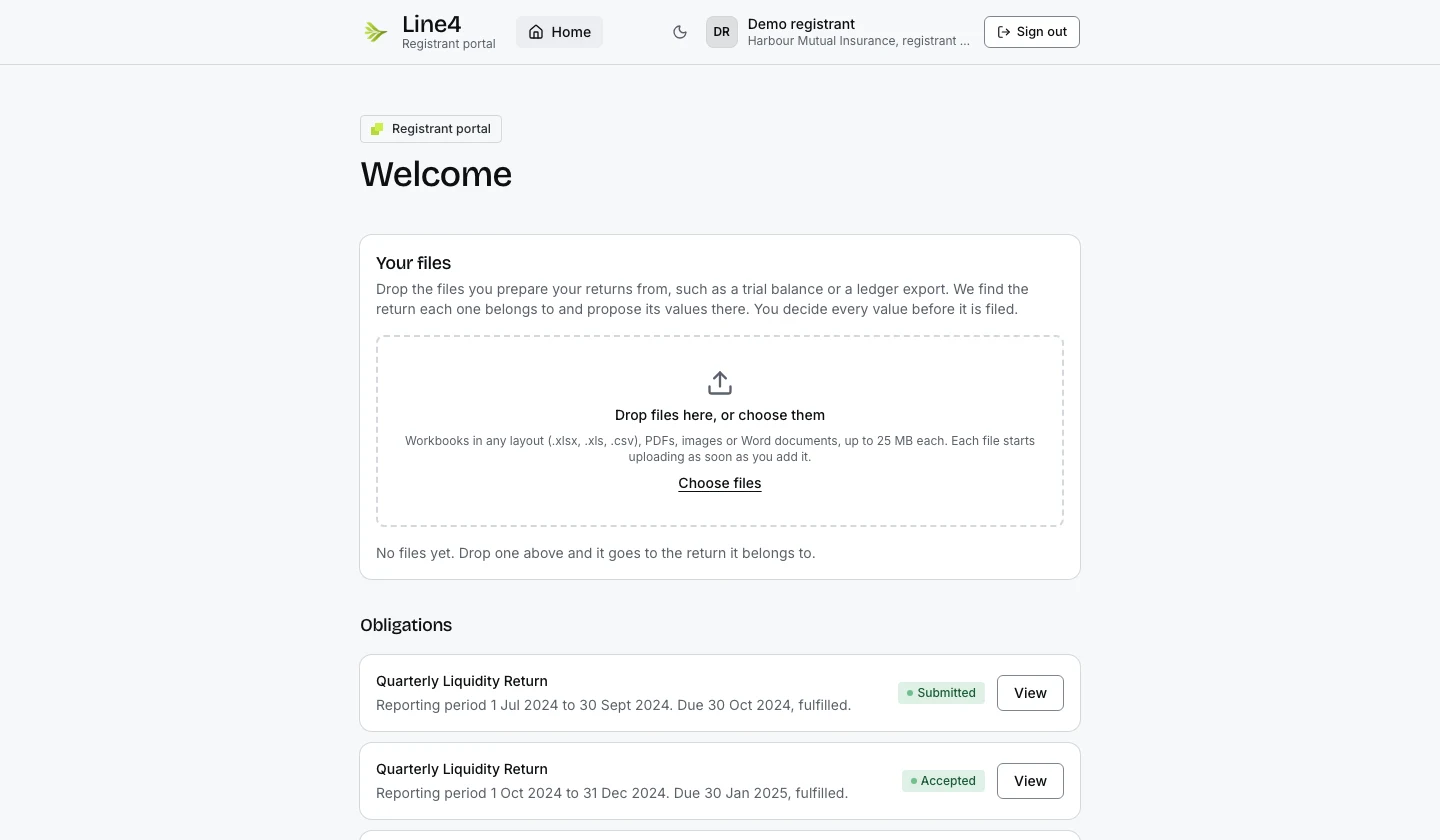
Check an ESG risk data return before you submit it
Line4 Check runs all 3,889 of EBA's active ESG checks in your browser, on an xBRL-CSV package or an XBRL-XML instance. Try it on the EBA’s own sample, or drop in your own file. It is a free check to catch problems early, not a substitute for your authority’s own validation.
Line4 Check runs all 3,889 of EBA's active checks, on an xBRL-CSV package or an XBRL-XML instance. Your file never leaves your computer. It is a free check, not a substitute for your authority's own validation.
- Environmental, social and governance risks (ESG)3,889 of 3,889 checks · 100%
Why checking at submission matters
Most of these checks are warnings, so a Pillar 3 or ESG return can be accepted with exceptions that nobody looks at until later. Run at the point of submission, the same rules give the firm an answer in seconds, while there is still time to fix the file, and give the supervisor data it can rely on from day one.
That is the first step to real-time supervision: validated data, sent straight from the firm’s systems, seen as it changes. On top of it, AI can read the movements that matter, such as a bank’s exposure to carbon-intensive sectors rising between two half-years, and draft the question for a supervisor, citing the cells behind it. Rules decide whether the data is right. Supervisors decide what it means.
- 1Check which templates are due this period for your type of institution: the EBA frequency file sets it template by template.
- 2Send the numbers in xBRL-CSV and the narrative in the PDF report, on the day you publish your financial statements.
- 3Keep your contact persons template X 01.00 up to date, and file it by 31 January.
- 4For the ESG risk data, use the format your own supervisor sets.
- 5Watch the new ESG disclosure templates from reference date 31 December 2026.
Where Line4 fits
Line4 is SupTech software for financial regulators. It collects returns in XBRL, Excel and CSV by portal, API or MCP, validates them against your taxonomies and rules at the point of submission (see XBRL software for regulators), and puts AI to work reading them, with supervisors making every decision. If you work with a standard we have not yet run in production, we will say so plainly and show you how we would approach it.
returns.inbox
- liquidity_2026Q3.xbrlok
- aml_annual_2026.xlsxflag
- capital_2026Q3.csvok
- solvency_2026Q3.xbrlflag
rules deterministic
- V-101Schema valid
- V-214Totals reconcile
- P-330Plausible vs history
ai.read liquidity_2026Q3.xbrl
cases.open
- Waiting for findings
Sample data. AI reads. Rules check. A supervisor decides.
You can try validation at the gate now on an EBA filing: Line4 Check, our regulatory filing checker, runs EBA's own rules on filings for 42 EBA modules, in xBRL-CSV or XBRL-XML, in your browser, without uploading anything. It is free to use. Guides to the returns it checks: IRRBB reporting, Liquidity reporting, NSFR reporting, Resolution and MREL reporting, ALMM reporting, Asset encumbrance reporting, PSD2 fraud reporting, Funding plans reporting, Supervisory benchmarking, DORA register of information, AIFMD reporting, ORSA reporting, MiFIR transaction reporting, EMIR reporting, US Call Report, FRTB reporting and Investment firm reporting.
In the returns library
One page per return: who files it, how often and by when, the format and the validation rules, with links to the official documents.
- Pillar 3 common disclosures (CODIS)EBA
- Pillar 3 ESG disclosures (ESGDIS)EBA
- Pillar 3 financial disclosures (FINDIS)EBA
- Pillar 3 data hub contact persons (P3DH)EBA
- ESG risk data collection (from Pillar 3 disclosures)EBA
- ESG risk dataBundesbank
- Pillar 3 disclosure report (Relatório de Pilar 3)BCB
- Pillar 3 public disclosure, market discipline and transparency (Cap. 21-20)CMF
- Pillar 3 public disclosuresCBN
Browse every return in the library.
Questions
What is Pillar 3 reporting?
The disclosure of a bank’s capital, risk and risk management data in fixed templates, so the market can compare banks. It is the third pillar of the Basel capital framework. In the EU the templates are set by Implementing Regulation (EU) 2024/3172, and the data goes to the EBA Pillar 3 data hub.
What is the EBA Pillar 3 data hub?
The EBA’s single access point where the Pillar 3 disclosures of EU and EEA banks can be found and compared. Institutions other than small and non-complex ones send their disclosures to it directly, in xBRL-CSV with a PDF report, on the day they publish their financial statements.
What are Pillar 3 ESG disclosures?
The disclosures on environmental, social and governance risks under Article 449a CRR: the EBA’s ESGDIS module, 13 templates in release 4.2, including climate transition risk by sector, physical risk, the green asset ratio and the banking book taxonomy alignment ratio. Large listed institutions disclose them twice a year.
What is the EBA ESG risk data collection?
The collection under EBA Decision EBA/DC/498, in which national supervisors pass to the EBA the quantitative ESG data that large listed banks disclose in Pillar 3. It is semi-annual, as at 30 June and 31 December, in templates D 01.00 to D 10.00, and the EBA calls it an interim solution.
What is the difference between Pillar 3 and supervisory reporting?
Supervisory reporting, such as COREP and FINREP, goes to the supervisor and stays private. Pillar 3 is published, so the market can see it. In the EU the EBA publishes both as modules of its reporting framework: the Pillar 3 modules joined it in release 4.1, for reference date June 2025.
What is the equivalent of Pillar 3 outside Europe?
Many countries outside Europe have one. Brazil’s banks publish a Pillar 3 report under Resolução BCB 54, Chile’s under chapter 21-20 of the CMF’s rules, and Nigeria’s under the Central Bank of Nigeria’s guidance notes on Pillar 3 disclosure.
What is Pillar 3 reporting software?
Software that builds the disclosures on the bank’s side, or collects and checks them on the supervisor’s side. Line4 is Pillar 3 reporting software for supervisors: it collects each Pillar 3 or ESG file and checks it against the EBA’s rules on arrival. Line4 Check also runs the ESG risk data checks on a bank’s file in the browser, free.
- EBA: Implementing Regulation (EU) 2024/3172 on public disclosures
- EBA: Pillar 3 data hub
- EBA: final draft ITS on the Pillar 3 data hub (EBA/ITS/2025/01)
- EBA: frequency of Pillar 3 disclosures
- EBA Decision EBA/DC/498 on the ESG data collection
- EBA: reporting framework 4.4
- Banco Central do Brasil: Resolução BCB 54
- CMF Chile: chapter 21-20, market discipline and transparency
- Central Bank of Nigeria: guidance notes on Pillar 3 disclosure