
What investment firm reporting covers
Since June 2021, EU investment firms that are not run like banks have their own prudential rules: the Investment Firms Regulation (Regulation (EU) 2019/2033) and Directive. The reporting that goes with them is set by Commission Implementing Regulation (EU) 2021/2284, amended by Implementing Regulation (EU) 2025/2159 of 27 October 2025.
The returns let a supervisor check a firm’s own funds, its capital requirements, its concentration risk, its liquidity and its level of activity. The EBA built them to be proportionate to the size and business of the firm, so there are two.
Who files, and when
A firm that meets the conditions in Article 12(1) of the IFR counts as small and non-interconnected, which the EBA calls class 3. Every other investment firm under the IFR is class 2. A firm moves to the class 2 return as soon as it no longer qualifies as class 3.
Class 2 firms report as at 31 March, 30 June, 30 September and 31 December, by close of business on 12 May, 11 August, 11 November and 11 February. Class 3 firms report as at 31 December, by 11 February. A date that falls on a weekend or a public holiday moves to the next working day. National authorities then send the data to the EBA within 25 business days.
- Returns that accept the format
How national supervisors collect it
The EBA sets the content, but each firm files with its own supervisor, through that supervisor’s system. The Line4 returns library has the IFR returns at 13 national supervisors. A few of the routes:
The validation rules
The EBA’s list of validation rules has 261 active rules for the two investment firm modules. Written out for each row and column, they make 7,814 checks. Most are warnings, so a failing return can still be filed, but the supervisor can ask the firm to explain it.
Outside Europe: the US FOCUS Report
In the US, every broker-dealer registered with the SEC files the FOCUS Report (Form X-17A-5), so the SEC and the self-regulatory organisations can watch its net capital and customer protection between examinations. Part I is monthly, due within 10 business days; Part II and IIA are quarterly, due within 17 business days; the Part III annual report is due within 60 days of the year end.
In Colombia, stockbroking firms and investment management companies declare each month and quarter that they meet the minimum solvency ratio the SFC sets (Formato 423), through the SFC’s web reporting application.
What Line4 does for investment firm reporting
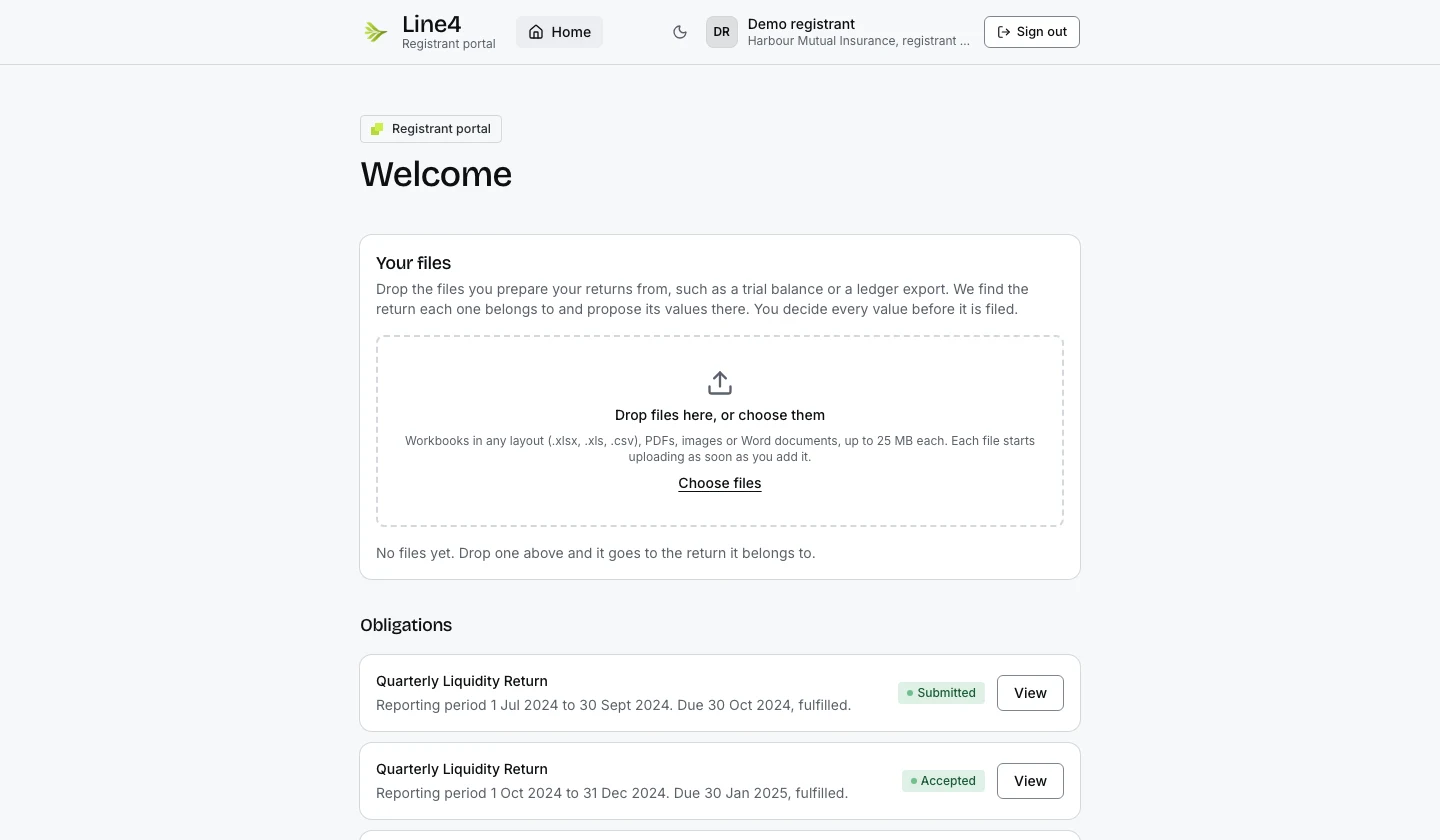
Line4 is investment firm regulatory reporting software for the supervisor. Firms send their IFR returns straight from their own systems, by portal, API or MCP, in xBRL-CSV or XBRL-XML. Line4 runs the EBA’s 7,814 investment firm checks on every file the moment it arrives, tracks each return against its deadline, and keeps each accepted return as data a supervisor can compare across firms and quarters.
For firms, Line4 Check runs all 7,814 of EBA's active investment firm checks in the browser before the return is filed, free. The file never leaves the firm’s computer.
Check an investment firm return before you submit it
Line4 Check runs all 7,814 of EBA's active investment firm checks in your browser, on an xBRL-CSV package or an XBRL-XML instance. Try it on the EBA’s own sample, or drop in your own file. It is a free check to catch problems early, not a substitute for your authority’s own validation.
Line4 Check runs all 7,814 of EBA's active checks across these 2 modules, on an xBRL-CSV package or an XBRL-XML instance. Your file never leaves your computer. It is a free check, not a substitute for your authority's own validation.
- Investment firms, class 2 (IFR class 2)7,736 of 7,736 checks · 100%Try EBA's sample →
- Investment firms, class 3 (IFR class 3)78 of 78 checks · 100%Try EBA's sample →
Why checking at submission matters
Most of these checks are warnings, so a investment firm return can be accepted with exceptions that nobody looks at until later. Run at the point of submission, the same rules give the firm an answer in seconds, while there is still time to fix the file, and give the supervisor data it can rely on from day one.
That is the first step to real-time supervision: validated data, sent straight from the firm’s systems, seen as it changes. On top of it, AI can read the movements that matter, such as a firm’s client money or daily trading flow climbing towards the class 3 limits, and draft the question for a supervisor, citing the cells behind it. Rules decide whether the data is right. Supervisors decide what it means.
- 1Check your class first: the I 05.00 threshold review shows whether you still qualify as class 3.
- 2Report the K-factor detail in the I 06 templates, not only the totals in I 04.00.
- 3Use the format and portal your own supervisor sets.
- 4Run the file against the EBA’s rules, and explain any warning before the remittance date.
Where Line4 fits
Line4 is SupTech software for financial regulators. It collects returns in XBRL, Excel and CSV by portal, API or MCP, validates them against your taxonomies and rules at the point of submission (see XBRL software for regulators), and puts AI to work reading them, with supervisors making every decision. If you work with a standard we have not yet run in production, we will say so plainly and show you how we would approach it.
returns.inbox
- liquidity_2026Q3.xbrlok
- aml_annual_2026.xlsxflag
- capital_2026Q3.csvok
- solvency_2026Q3.xbrlflag
rules deterministic
- V-101Schema valid
- V-214Totals reconcile
- P-330Plausible vs history
ai.read liquidity_2026Q3.xbrl
cases.open
- Waiting for findings
Sample data. AI reads. Rules check. A supervisor decides.
You can try validation at the gate now on an EBA filing: Line4 Check, our regulatory filing checker, runs EBA's own rules on filings for 42 EBA modules, in xBRL-CSV or XBRL-XML, in your browser, without uploading anything. It is free to use. Guides to the returns it checks: IRRBB reporting, Liquidity reporting, NSFR reporting, Resolution and MREL reporting, ALMM reporting, Asset encumbrance reporting, PSD2 fraud reporting, Funding plans reporting, Supervisory benchmarking, DORA register of information, AIFMD reporting, ORSA reporting, MiFIR transaction reporting, EMIR reporting, US Call Report, FRTB reporting and Pillar 3 reporting.
In the returns library
One page per return: who files it, how often and by when, the format and the validation rules, with links to the official documents.
- Investment firm prudential report, class 2 firms, quarterly (IF_CLASS2)EBA
- Investment firm prudential report, class 3 (small and non-interconnected) firms, annual (IF_CLASS3)EBA
- Investment firm prudential report: Class 2 firms (IFR, IF_CLASS2)CBI
- Investment firm prudential report: medium-sized firms, IFR Article 54 (IF_CLASS2)Bundesbank
- Investment firm prudential report, class 2 (IFREP, IF_CLASS2)DNB
- Investment firm prudential report, class 2 brokerage houses (DM_IF, IF CLASS 2)KNF
- FOCUS Report, broker-dealer financial and operational report (Form X-17A-5)SEC
- Minimum solvency ratio control, stockbrokers and investment managers (Formato 423)SFC
Browse every return in the library.
Questions
What is regulatory reporting for investment firms?
The returns an investment firm files with its supervisor. In the EU these are the IFR returns: class 2 firms file IF_CLASS2 each quarter and small and non-interconnected class 3 firms file IF_CLASS3 each year, covering own funds, K-factor requirements, concentration risk and liquidity.
What are the IFR reporting deadlines?
Class 2 firms report as at each quarter end, by close of business on 12 May, 11 August, 11 November and 11 February. Class 3 firms report as at 31 December, by 11 February. A weekend or public holiday moves the date to the next working day (Implementing Regulation (EU) 2021/2284, Article 2).
What is the difference between class 2 and class 3 investment firms?
Class 3 firms are small and non-interconnected under Article 12(1) of the IFR, and file a short annual return of six templates. Every other IFR firm is class 2 and files the full quarterly return, with the K-factor and concentration risk detail.
What are K-factors?
The measures the IFR uses to size an investment firm’s capital requirement from its business: for example assets under management, client money held, client orders handled and daily trading flow. Class 2 firms report them in templates I 04.00 and I 06.
What is the equivalent of IFR reporting outside Europe?
In the US, registered broker-dealers file the FOCUS Report (Form X-17A-5) with the SEC and their examining authority: monthly, quarterly and annual parts on net capital and operations. In Colombia, stockbrokers report their minimum solvency ratio to the SFC each month and quarter.
What is investment firm regulatory reporting software?
Software that builds the IFR return on the firm’s side, or collects and checks it on the supervisor’s side. Line4 is investment firm regulatory reporting software for supervisors: it collects each IFR return and runs the EBA’s checks on arrival. Line4 Check also runs them on a firm’s file in the browser, free.
- EBA: ITS on reporting and disclosures for investment firms
- EBA: final draft ITS on reporting and disclosures for investment firms (Implementing Regulation (EU) 2021/2284)
- Implementing Regulation (EU) 2025/2159
- EBA: reporting framework 4.2
- EBA: validation rules packages
- Central Bank of Ireland: MiFID requirements
- US Code of Federal Regulations: 17 CFR 240.17a-5