
What the Call Report is for
The Call Report, formally the Consolidated Reports of Condition and Income, is how the Federal Reserve, the FDIC and the OCC see every bank’s finances each quarter: assets and loans, deposits, capital, income, past due loans, and dozens of supporting schedules. The agencies use it to supervise each bank and publish it bank by bank. The FFIEC, the US interagency examination council, sets the forms.
It is filed as of the close of business on the last day of each quarter. Some schedules and items are reported only half-yearly or yearly.
FFIEC 031 vs 041 vs 051: which banks file which
The three forms cover the same report at three levels of detail. Size is measured each June 30 for the following year.
- Returns that accept the format
How it is filed: XBRL to the CDR
Every Call Report goes to the FFIEC’s Central Data Repository (CDR), which takes it only as an XBRL instance, built to XBRL 2.1 and the CDR taxonomy for that report date. The FFIEC publishes a new taxonomy every quarter, each with its date in the file name.
The CDR must receive the report no later than 30 calendar days after the report date, or 35 days for a bank with more than one foreign office. A due date on a weekend or holiday moves to the next business day, and no other extensions are allowed.
Once accepted, each bank’s Call Report is public on the CDR, searchable by bank and downloadable as PDF, delimited text or XBRL, typically about 6 hours after it is filed.
The edits: validity and quality
The checks travel inside the taxonomy, as a formula linkbase in the FFIEC’s own expression language. By Line4’s count of the September 2026 packages, each of the three forms carries the same 3,615 edits: 1,046 validity edits and 2,569 quality edits, and 870 of the quality edits compare a figure with earlier quarters. A further 243 sum checks sit in the calculation linkbase.
Credit union Call Reports: the NCUA 5300
Every federally insured credit union files the NCUA Form 5300 quarterly, through NCUA’s CUOnline system: typed into its online forms, or built offline and imported as XML against the schema NCUA publishes each cycle. It is due by 11:59:59 p.m. Eastern on the 30th day after the quarter end. NCUA’s September 2026 edit file holds 983 edit codes: errors must be resolved before the report is accepted, while warnings and historical checks against earlier quarters are advisory.
The equivalent outside the US
In the EU, banks report the same ground in FINREP (financial statements) and COREP (capital and risk), built to the EBA’s XBRL taxonomy and checked against its published rules, through their national supervisor. In Canada there is no XBRL for bank returns: banks file to OSFI through its Regulatory Reporting System, and the capital return, BCAR, is collected as XML.
What Line4 does for the Call Report
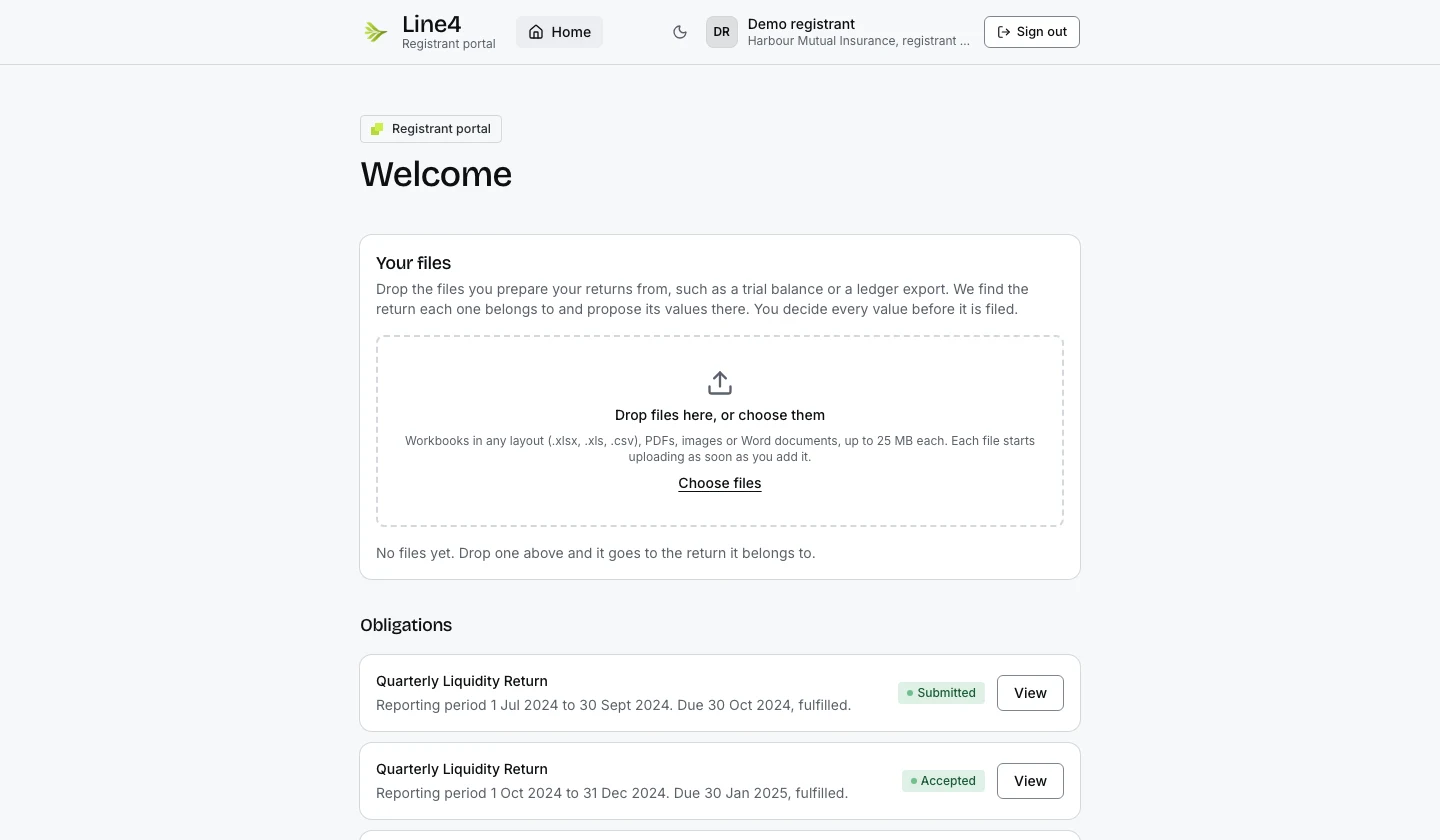
Line4 is Call Report software for supervisors. Banks and credit unions send their reports straight from their own systems, by portal, API or MCP, in XBRL, XML or web forms. Line4 runs the published edits on every file the moment it arrives, shows which validity edits failed and which quality edits carry an explanation, and keeps each accepted report as data a supervisor can compare across banks and quarters.
For banks, Line4 Check runs the FFIEC’s own edits on a Call Report file in the browser before it goes to the CDR, free. It runs 1,632 of the 2,184 checks that apply to an FFIEC 031 report, 1,468 of the 1,928 checks that apply to an FFIEC 041 report and 1,096 of the 1,484 checks that apply to an FFIEC 051 report, and the file is never uploaded.
Why checking at submission matters
Most of these checks are warnings, so a Call Report can be accepted with exceptions that nobody looks at until later. Run at the point of submission, the same rules give the firm an answer in seconds, while there is still time to fix the file, and give the supervisor data it can rely on from day one.
That is the first step to real-time supervision: validated data, sent straight from the firm’s systems, seen as it changes. On top of it, AI can read the movements that matter, such as a bank whose deposits fall sharply in one quarter while its borrowings jump, and draft the question for a supervisor, citing the cells behind it. Rules decide whether the data is right. Supervisors decide what it means.
- 1Confirm your form: 031, 041 or 051, by your offices and your assets on June 30.
- 2Build the file against the CDR taxonomy for this quarter’s report date, not last quarter’s.
- 3Run the validity and quality edits, fix every validity failure and explain every quality one.
- 4Submit to the CDR within 30 days of the quarter end, 35 with more than one foreign office.
Where Line4 fits
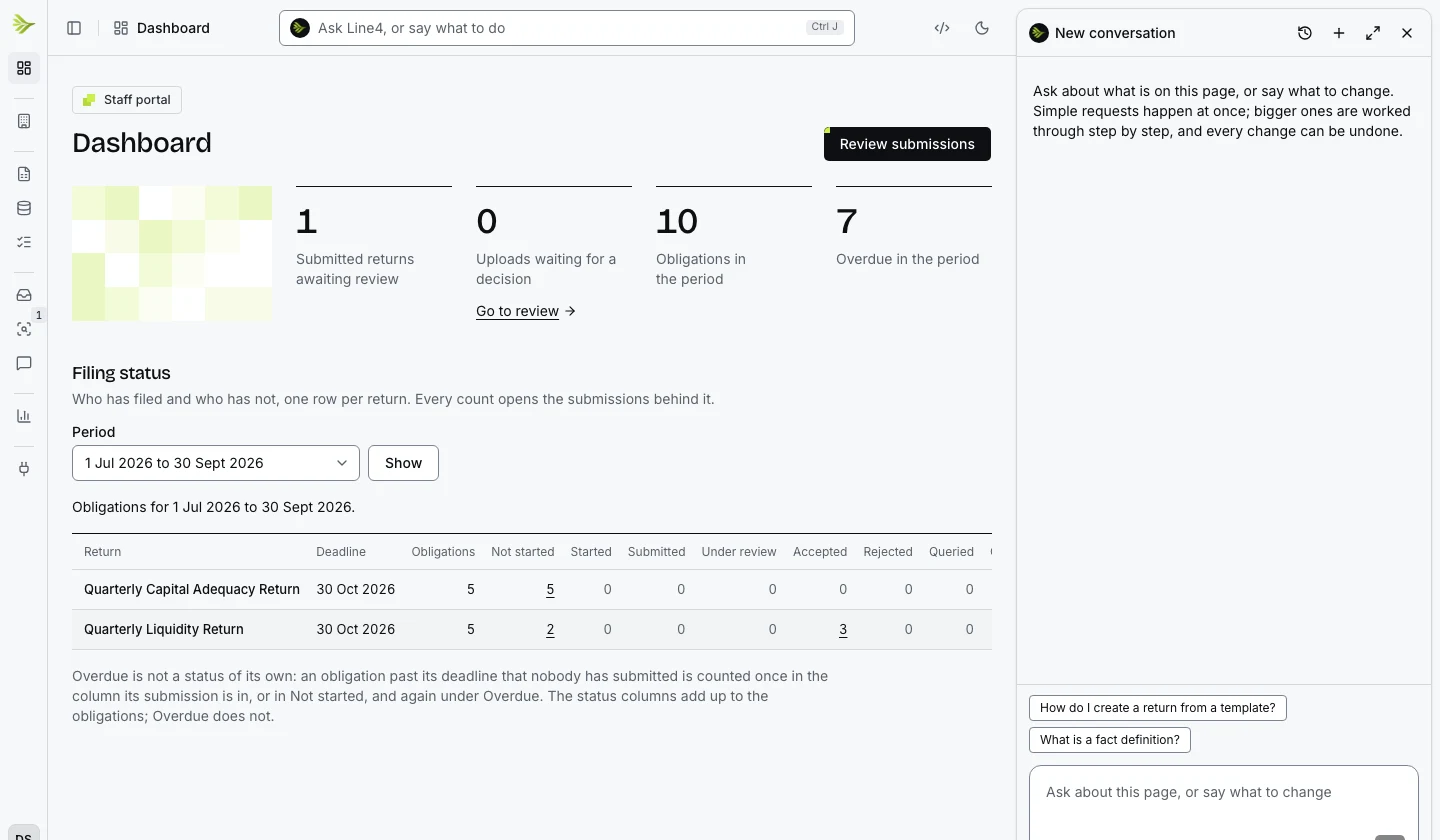
Line4 is SupTech software for financial regulators. It collects returns in XBRL, Excel and CSV by portal, API or MCP, validates them against your taxonomies and rules at the point of submission (see XBRL software for regulators), and puts AI to work reading them, with supervisors making every decision. If you work with a standard we have not yet run in production, we will say so plainly and show you how we would approach it.
returns.inbox
- liquidity_2026Q3.xbrlok
- aml_annual_2026.xlsxflag
- capital_2026Q3.csvok
- solvency_2026Q3.xbrlflag
rules deterministic
- V-101Schema valid
- V-214Totals reconcile
- P-330Plausible vs history
ai.read liquidity_2026Q3.xbrl
cases.open
- Waiting for findings
Sample data. AI reads. Rules check. A supervisor decides.
In the returns library
One page per return: who files it, how often and by when, the format and the validation rules, with links to the official documents.
- Call Report for banks with foreign offices (FFIEC 031)FFIEC
- Call Report for banks with domestic offices only (FFIEC 041)FFIEC
- Call Report for smaller banks with domestic offices only (FFIEC 051)FFIEC
- Quarterly call report (NCUA 5300)NCUA
Browse every return in the library.
Questions
What is an FFIEC Call Report?
The quarterly Consolidated Reports of Condition and Income every US bank files with the Federal Reserve, FDIC and OCC, on forms set by the FFIEC. It covers the balance sheet, income statement and supporting schedules, and is filed as XBRL to the FFIEC Central Data Repository.
What is the difference between FFIEC 031, 041 and 051?
The office structure and size of the bank. The 031 is for banks with a foreign office, or with $100 billion or more in assets or advanced approaches capital. The 041 is for banks with domestic offices only under $100 billion. The 051 is a shorter form for domestic banks under $5 billion.
When is the Call Report due?
The CDR must receive it within 30 calendar days of the quarter end, or 35 days for a bank with more than one foreign office. A due date on a weekend or holiday moves to the next business day, and there are no other extensions.
Where are the Call Report instructions for the 041 and 051?
The FDIC publishes the current forms and instructions for the FFIEC 031, 041 and 051 each quarter, with the General Instructions for each form. The FFIEC publishes the taxonomy and its edits on the CDR before each quarter end.
How do I search for a bank’s Call Report?
On the FFIEC CDR public site, by bank name or identifier and quarter. Each report can be downloaded as PDF, delimited text or XBRL, usually about 6 hours after the bank files. NCUA publishes credit union Call Report data by quarter back to 1994.
What Call Report software is there?
Banks build the XBRL file in their own reporting or core banking software. On the supervisor’s side, Line4 is Call Report software that collects each report and runs the published edits on arrival. Line4 Check also runs the FFIEC edits on a bank’s file in the browser before it is filed, free.
What is a credit union Call Report?
The NCUA Form 5300, filed quarterly by every federally insured credit union through NCUA’s CUOnline, due on the 30th day after the quarter end. NCUA’s September 2026 cycle has 983 edit codes.
- FDIC: Call Report forms, instructions and related materials
- FDIC: FFIEC 031 and 041 General Instructions, September 2026
- FDIC: FFIEC 051 General Instructions
- FFIEC CDR: Interchange Specification
- FFIEC CDR: taxonomy downloads
- FFIEC CDR: Institution Reports
- NCUA: CUOnline
- NCUA: Call Report edit codes, September 2026
- OSFI: BCAR FAQ and technical specification