
What EMIR reporting is for
EMIR reporting lets regulators see risk building up in derivatives markets: who holds which swaps, futures and options, with whom, how big they are, and how much margin backs them. It was the EU’s answer to the 2008 crisis, when no authority could see who was exposed to whom.
Like MiFIR transaction reporting, it is not a periodic return. A report is sent for each derivative, and again each time it is modified or ended, every working day.
Who reports, and to whom
Both counterparties to a derivative report it, financial and non-financial, or an entity responsible for reporting does it for them. Reports go to a trade repository (TR), not to a regulator. ESMA registers and supervises the TRs, and they collect and keep the record of every derivative contract.
The deadline is T+1: no later than the working day after the derivative is concluded, modified or ended. National regulators, ESMA and other authorities then read the data straight from the TRs, under EMIR’s data access rules.
- Returns that accept the format
EMIR REFIT: what changed on 29 April 2024
EMIR REFIT rewrote how derivatives are reported. The new reporting standards applied from 29 April 2024, moved every report to ISO 20022 XML, and came with a new set of validation rules and reconciliation tolerances, last updated by ESMA on 6 September 2023.
EMIR 3: the active account report
EMIR 3 added a second report. Counterparties under the Active Account Requirement in Article 7b must show they hold active accounts at EU central counterparties for certain systemically important clearing services. They report to their own regulator, not to a TR, in CSV files built to ESMA’s four templates.
The report is semi-annual: by the last day of January and the last day of July, each covering the previous 12 months, under Commission Delegated Regulation (EU) 2026/305. The first was due by 31 July 2026.
SFTR and MiFIR: the other EU trade reports
SFTR covers securities financing: repos, securities lending and margin lending. It also goes to trade repositories by T+1 in ISO 20022 XML, with 155 ESMA validation rules. MiFIR transaction reporting is different: investment firms report trades in financial instruments to their national regulator, not to a TR.
Outside Europe: Australia
In Australia, the ASIC Derivative Transaction Rules (Reporting) 2024 make Australian ADIs, AFS licensees and other reporting entities report each OTC derivative, and every change to it, to a licensed trade repository by the end of the second business day in Sydney. Reports use ISO 20022 XML, as in the EU. The amended rules started on 21 October 2024.
What Line4 does for EMIR reporting
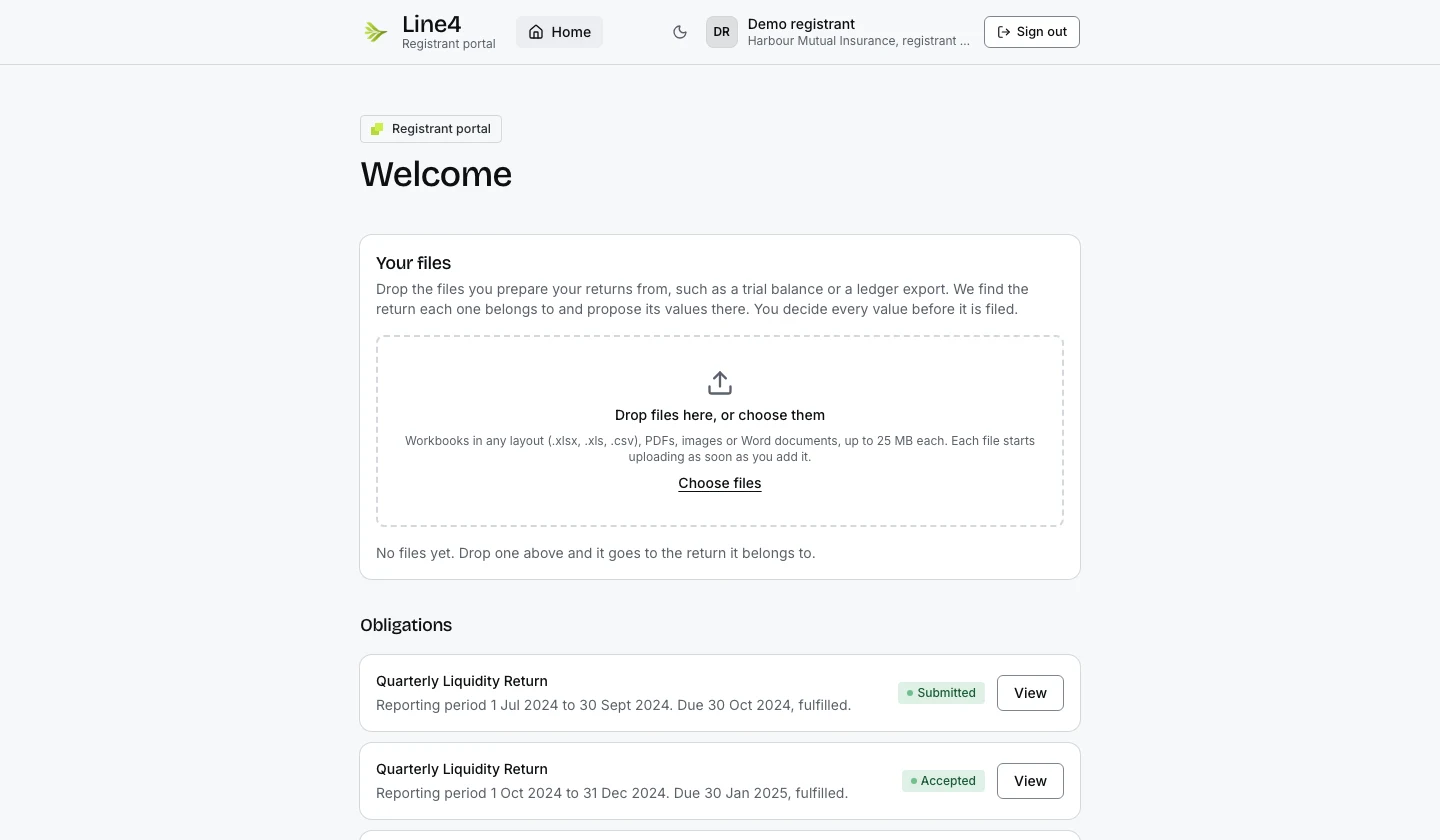
Line4 is EMIR reporting software for the supervisor. It takes derivatives data in, from trade repositories or straight from firms by API or MCP, and checks every record against ESMA’s 490 validation rules the moment it arrives, with the EMIR-VR code and the field behind each error. Every accepted report is kept as structured data a supervisor can query.
On top of that data, Line4 shows the exposures a supervisor looks for, such as one counterparty building a large one-way position or a firm whose reports stop, and drafts the question for a supervisor to decide.
Why checking at submission matters
Most of these checks are warnings, so a derivatives report can be accepted with exceptions that nobody looks at until later. Run at the point of submission, the same rules give the firm an answer in seconds, while there is still time to fix the file, and give the supervisor data it can rely on from day one.
That is the first step to real-time supervision: validated data, sent straight from the firm’s systems, seen as it changes. On top of it, AI can read the movements that matter, such as a counterparty’s uncollateralised exposure doubling in a week, and draft the question for a supervisor, citing the cells behind it. Rules decide whether the data is right. Supervisors decide what it means.
- 1Confirm which derivatives you report, and whether you or an entity responsible for reporting sends each one.
- 2Build each report to ESMA’s current ISO 20022 XML schema and check it against the EMIR REFIT validation rules.
- 3Check every LEI is current and the trade identifier matches your counterparty’s.
- 4Report by T+1, including every modification and termination, and read the TR’s feedback the same day.
- 5Tell your regulator about data quality issues you find, using ESMA’s template.
Where Line4 fits
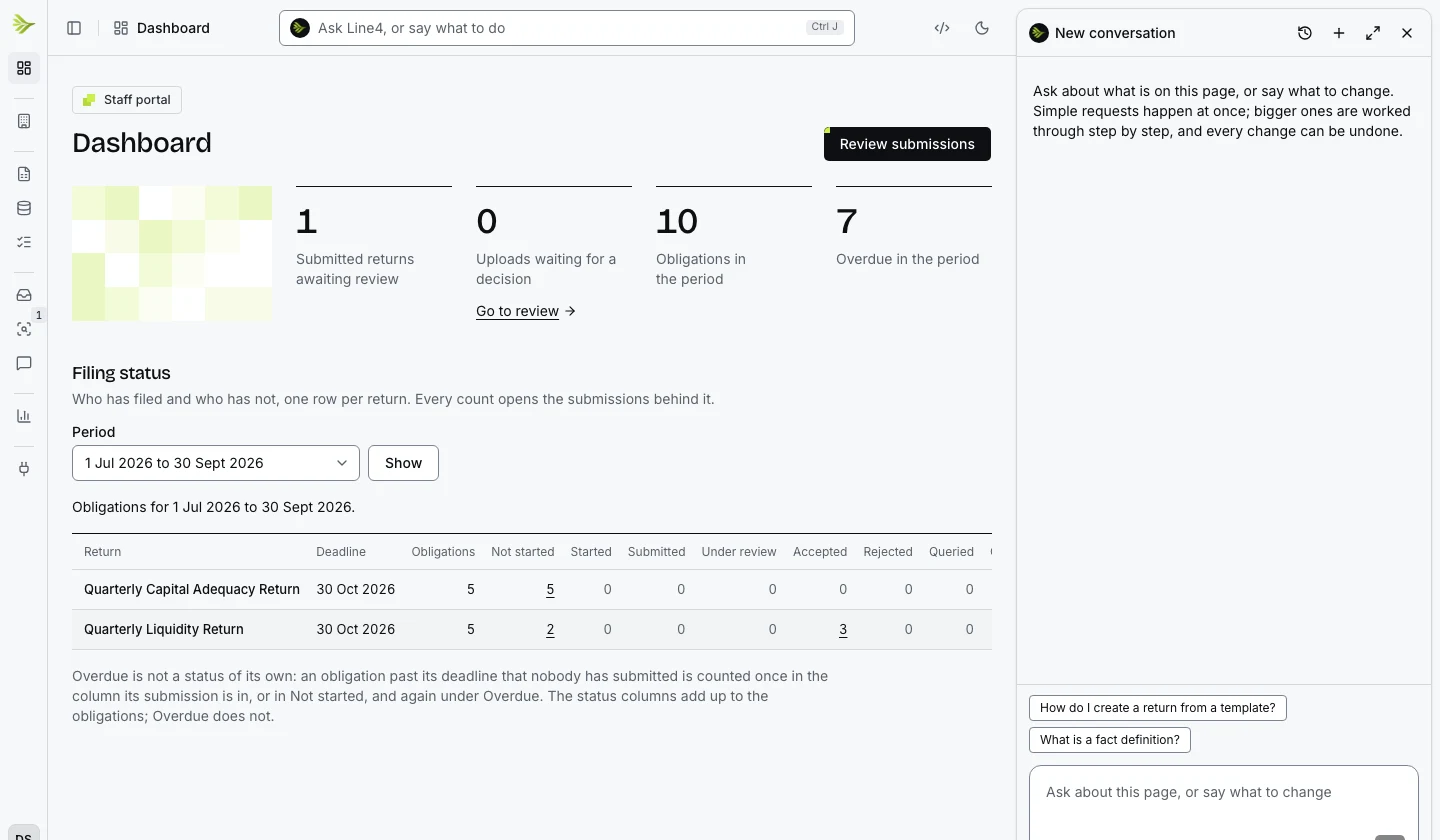
Line4 is SupTech software for financial regulators. It collects returns in XBRL, Excel and CSV by portal, API or MCP, validates them against your taxonomies and rules at the point of submission (see XBRL software for regulators), and puts AI to work reading them, with supervisors making every decision. If you work with a standard we have not yet run in production, we will say so plainly and show you how we would approach it.
returns.inbox
- liquidity_2026Q3.xbrlok
- aml_annual_2026.xlsxflag
- capital_2026Q3.csvok
- solvency_2026Q3.xbrlflag
rules deterministic
- V-101Schema valid
- V-214Totals reconcile
- P-330Plausible vs history
ai.read liquidity_2026Q3.xbrl
cases.open
- Waiting for findings
Sample data. AI reads. Rules check. A supervisor decides.
In the returns library
One page per return: who files it, how often and by when, the format and the validation rules, with links to the official documents.
- Derivatives trade reporting under EMIR (EMIR Art 9)ESMA
- Active Account Requirement (AAR) reporting (EMIR Art 7b)ESMA
- Securities financing transaction reporting (SFTR)ESMA
- OTC derivative transaction reportingASIC
Browse every return in the library.
Questions
What is EMIR reporting?
The duty to report every derivative contract, when it is concluded, modified or ended, to a trade repository by the next working day, under Article 9 of EMIR. Regulators read the data from the trade repositories to see risk in derivatives markets.
What is EMIR REFIT?
The revision of EMIR by Regulation (EU) 2019/834, and the new reporting standards that applied from 29 April 2024. REFIT moved every report to ISO 20022 XML and brought a new set of validation rules and reconciliation tolerances.
Who has to report under EMIR?
Both counterparties to a derivative, financial and non-financial, or an entity responsible for reporting on their behalf. They report to a trade repository registered and supervised by ESMA, not to ESMA itself.
What is the EMIR reporting deadline?
T+1: each derivative is reported no later than the working day after it is concluded, modified or ended. The EMIR 3 active account report is different: semi-annual, by the end of January and the end of July.
What are the EMIR validation rules?
ESMA’s EMIR REFIT validation rules: 490 numbered EMIR-VR error codes, 410 for the derivative and its counterparties and 80 for margins, saying when each field is mandatory, conditional or optional. Trade repositories apply them to every report they receive.
What is the difference between EMIR and MiFIR reporting?
EMIR covers derivatives and goes to a trade repository. MiFIR transaction reporting covers trades in financial instruments and goes to the firm’s national regulator. Both are due by T+1 and both use ISO 20022 XML.
What is EMIR reporting software?
Software that builds and sends EMIR reports on the firm’s side, or collects and checks them on the regulator’s side. Line4 is EMIR reporting software for supervisors: it takes derivatives data in, checks every record against ESMA’s 490 validation rules on arrival, and keeps it as data a supervisor can query.
- ESMA: EMIR reporting
- ESMA: EMIR REFIT validation rules and reconciliation tolerances
- ESMA: guidelines on reporting under EMIR REFIT
- EUR-Lex: Commission Delegated Regulation (EU) 2022/1858
- ESMA: active account requirement template instructions
- ESMA: SFTR reporting
- ASIC Derivative Transaction Rules (Reporting) 2024