
What MiFIR transaction reporting is for
Transaction reports let a regulator see every trade in its market: who bought or sold, for which client, which instrument, at what price and size, and which person or algorithm made the decision. Regulators use them to detect and investigate market abuse, to watch for fair and orderly markets, and to supervise investment firms.
It is not a periodic return. There is no quarter end: a firm sends a report for each transaction, every working day, and the regulator receives millions of records.
Who reports, and when
Investment firms, and banks providing investment services, report each transaction they execute. They can report themselves, through an approved reporting mechanism (ARM) acting for them, or through the trading venue, which also reports for firms that are not covered by MiFIR. Fund managers acting only within their fund mandate do not report under Article 26.
The deadline is the same everywhere: as quickly as possible, and no later than the close of the following working day. Firms may send reports in real time or in batches. National regulators then swap reports among themselves through ESMA’s Transaction Reporting Exchange Mechanism (TREM), so a trade in a French share reported in Ireland still reaches the French regulator. Reports do not go to ESMA directly.
- Returns that accept the format
How national regulators collect transaction reports
The returns library sets out 7 MiFIR transaction reporting returns at 7 regulators. The fields and rules are ESMA's. The route in and the file checks are each regulator's own.
What goes wrong in transaction reporting
Most rejections come from ESMA’s rules and from reference data. A report only passes if its instrument, its parties and its people can be found and match.
EMIR and SFTR: the other EU transaction reports
Two other EU regimes report trade by trade, also by T+1, but to trade repositories registered with ESMA rather than to a national regulator. EMIR covers derivatives, for both financial and non-financial counterparties. SFTR covers securities financing: repos, securities lending and margin lending. Both use ISO 20022 XML.
Outside Europe: the US and Australia
In the US, banks above a set size report their Treasury securities and agency debt trades to the Federal Reserve on the FR 2956, through FINRA’s TRACE system, within 60 minutes of execution during the trading day. The US Currency Transaction Report is a different thing: FinCEN’s anti-money laundering report on cash transactions over $10,000 in a business day, due within 15 calendar days.
In Australia, ASIC’s derivative transaction rules make banks, AFS licensees and other reporting entities report each OTC derivative, and every change to it, to a licensed trade repository by the end of the second business day in Sydney.
What Line4 does for transaction reporting
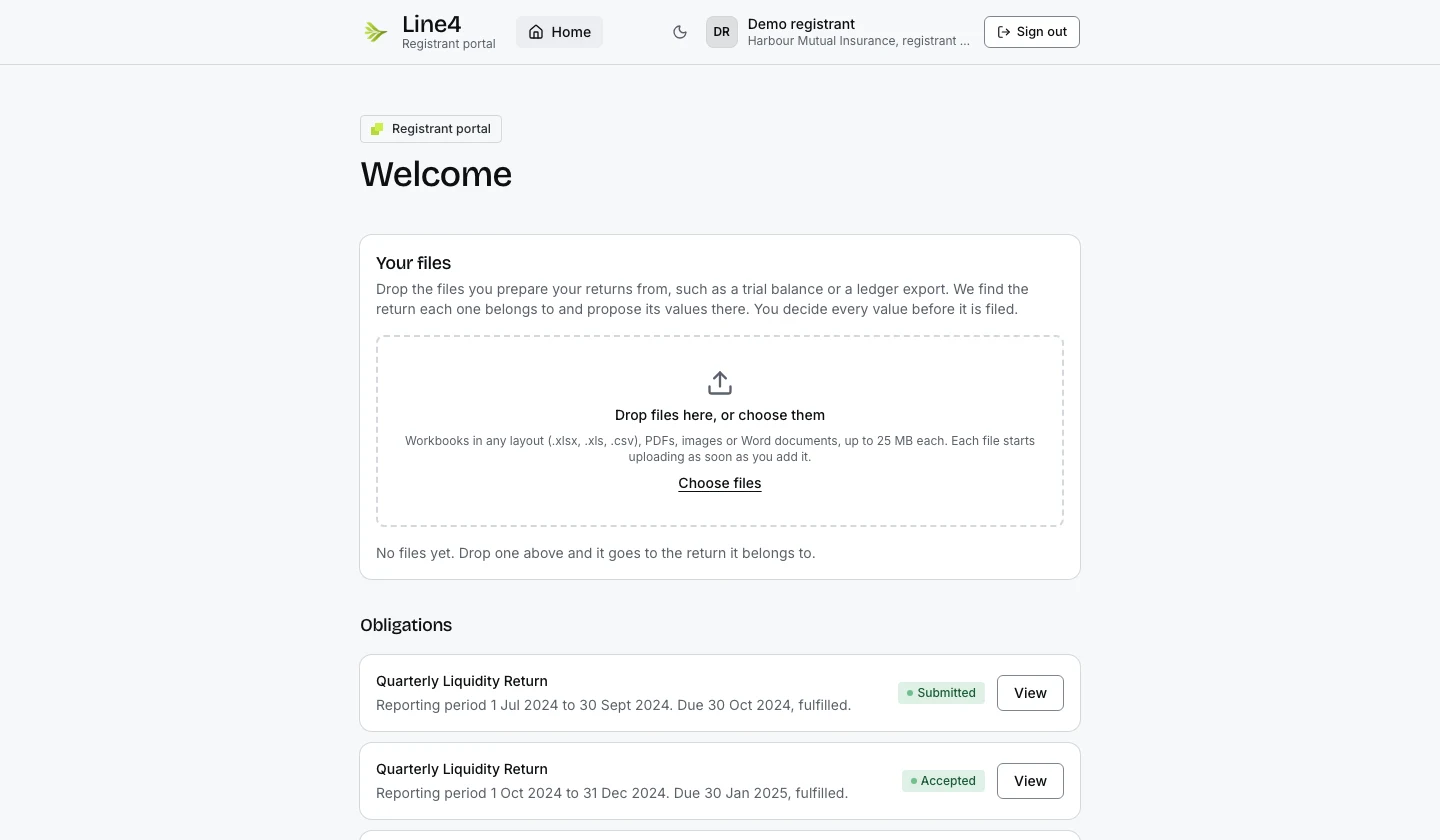
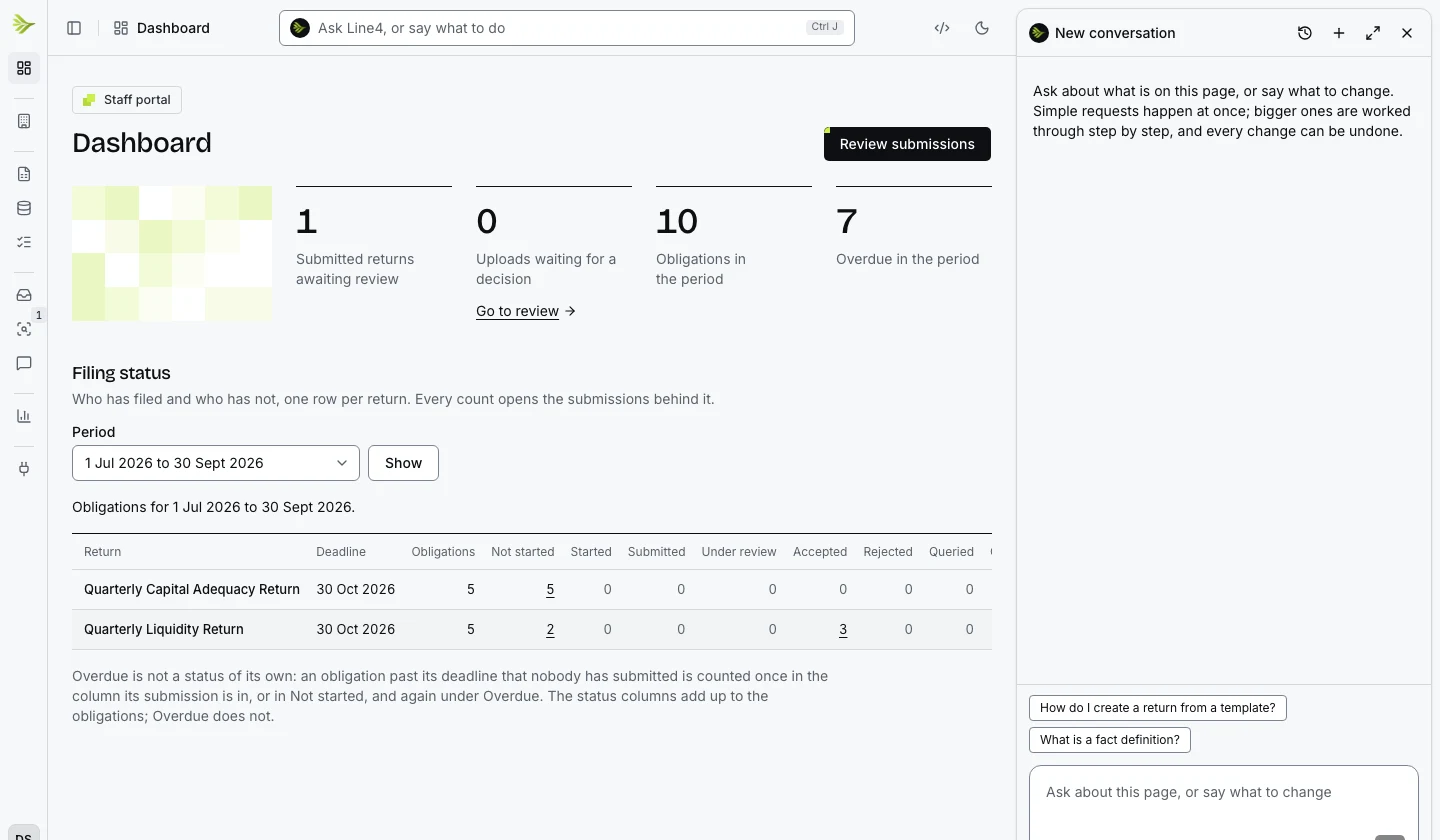
Line4 is transaction reporting software for the supervisor. Firms, ARMs and trading venues send their files straight from their own systems, by portal, API or MCP. Line4 checks every file against ESMA’s schema and 223 validation rules and against reference data the moment it arrives, sends the firm feedback in seconds, not overnight, and keeps every accepted report as structured data a supervisor can query.
On top of that data, Line4 shows the patterns a market abuse team looks for, such as a client trading just before news or a firm whose reports stop, and drafts the question for a supervisor to decide.
Why checking at submission matters
Most of these checks are warnings, so a transaction report can be accepted with exceptions that nobody looks at until later. Run at the point of submission, the same rules give the firm an answer in seconds, while there is still time to fix the file, and give the supervisor data it can rely on from day one.
That is the first step to real-time supervision: validated data, sent straight from the firm’s systems, seen as it changes. On top of it, AI can read the movements that matter, such as a client trading heavily in a share days before a takeover is announced, and draft the question for a supervisor, citing the cells behind it. Rules decide whether the data is right. Supervisors decide what it means.
- 1Confirm which of your trades are reportable, and whether you, an ARM or the venue sends each one.
- 2Validate each file against ESMA’s current XML schema and validation rules.
- 3Check every ISIN is in FIRDS and every LEI is current on the trade date.
- 4Send by the close of the next working day, and read the feedback file the same day.
- 5Tell your regulator about any errors or missed reports you find later.
Where Line4 fits
Line4 is SupTech software for financial regulators. It collects returns in XBRL, Excel and CSV by portal, API or MCP, validates them against your taxonomies and rules at the point of submission (see XBRL software for regulators), and puts AI to work reading them, with supervisors making every decision. If you work with a standard we have not yet run in production, we will say so plainly and show you how we would approach it.
returns.inbox
- liquidity_2026Q3.xbrlok
- aml_annual_2026.xlsxflag
- capital_2026Q3.csvok
- solvency_2026Q3.xbrlflag
rules deterministic
- V-101Schema valid
- V-214Totals reconcile
- P-330Plausible vs history
ai.read liquidity_2026Q3.xbrl
cases.open
- Waiting for findings
Sample data. AI reads. Rules check. A supervisor decides.
In the returns library
One page per return: who files it, how often and by when, the format and the validation rules, with links to the official documents.
- Transaction reports (MiFIR TR)CBI
- MiFIR transaction reporting (MiFIR Art 26)ESMA
- MiFIR transaction reporting (TRS)Finanstilsynet
- MiFIR transaction reports (Art. 26 MiFIR)BaFin
- Transaction reporting (MiFIR Article 26)FIN-FSA
- Transaction reporting (MiFIR Article 26)FI
- MiFIR transaction reporting (MiFIR TR / TRAFIM)CNB
- Derivatives trade reporting under EMIR (EMIR Art 9)ESMA
- Securities financing transaction reporting (SFTR)ESMA
- Treasury securities and agency debt/MBS transaction reporting (FR 2956)Federal Reserve Board
- OTC derivative transaction reportingASIC
- Currency Transaction Report (FinCEN CTR, Form 112)FinCEN
Browse every return in the library.
Questions
What is MiFIR transaction reporting?
The report an investment firm sends its national regulator for every transaction it executes in a financial instrument, under Article 26 of MiFIR, by the close of the next working day. Regulators use the reports to detect market abuse and supervise firms.
What is the difference between MiFID II and MiFIR transaction reporting?
None in practice. The duty sits in MiFIR (Regulation (EU) No 600/2014), the regulation that came with the MiFID II directive in January 2018, so people say MiFID II transaction reporting and MiFIR transaction reporting for the same thing.
What are the MiFIR transaction reporting fields?
Commission Delegated Regulation (EU) 2017/590 (RTS 22) sets 65 fields: the executing firm and the buyer and seller, the client and any decision maker, the instrument by ISIN, price, quantity and venue, and the person or algorithm behind the investment decision and the execution. ESMA turns them into an XML schema and validation rules.
Is transaction reporting real time?
It can be. MiFIR asks for reports as quickly as possible and no later than the close of the next working day, and regulators such as the Central Bank of Ireland let firms report in real time or in batches. In the US, the FR 2956 goes in within 60 minutes of each trade.
What is transaction reporting software?
Software that builds and sends transaction reports on the firm’s side, or collects and checks them on the regulator’s side. Line4 is transaction reporting software for supervisors: it takes reports straight from firms, ARMs and venues, checks each file against ESMA’s schema, 223 validation rules and reference data on arrival, and keeps every report as data a supervisor can query.
Is a currency transaction report the same as transaction reporting?
No. A US Currency Transaction Report (CTR) is FinCEN’s anti-money laundering report on cash transactions over $10,000, filed within 15 calendar days. Transaction reporting under MiFIR covers every trade in a financial instrument, by the next working day.
- ESMA: MiFIR reporting
- ESMA: MiFIR transaction reporting validation rules
- EUR-Lex: Regulation (EU) No 600/2014 (MiFIR)
- EUR-Lex: Commission Delegated Regulation (EU) 2017/590 (RTS 22)
- ESMA: EMIR reporting
- Central Bank of Ireland: MiFIR transaction reporting operational and technical arrangements
- BaFin: transaction reports under Article 26 MiFIR
- Finanstilsynet: MiFIR transaction reporting
- FIN-FSA: transaction reporting
- Federal Reserve: FR 2956
- ASIC Derivative Transaction Rules (Reporting) 2024
- FinCEN: Currency Transaction Report FAQs