
Network and connected-party analysis for financial supervisors
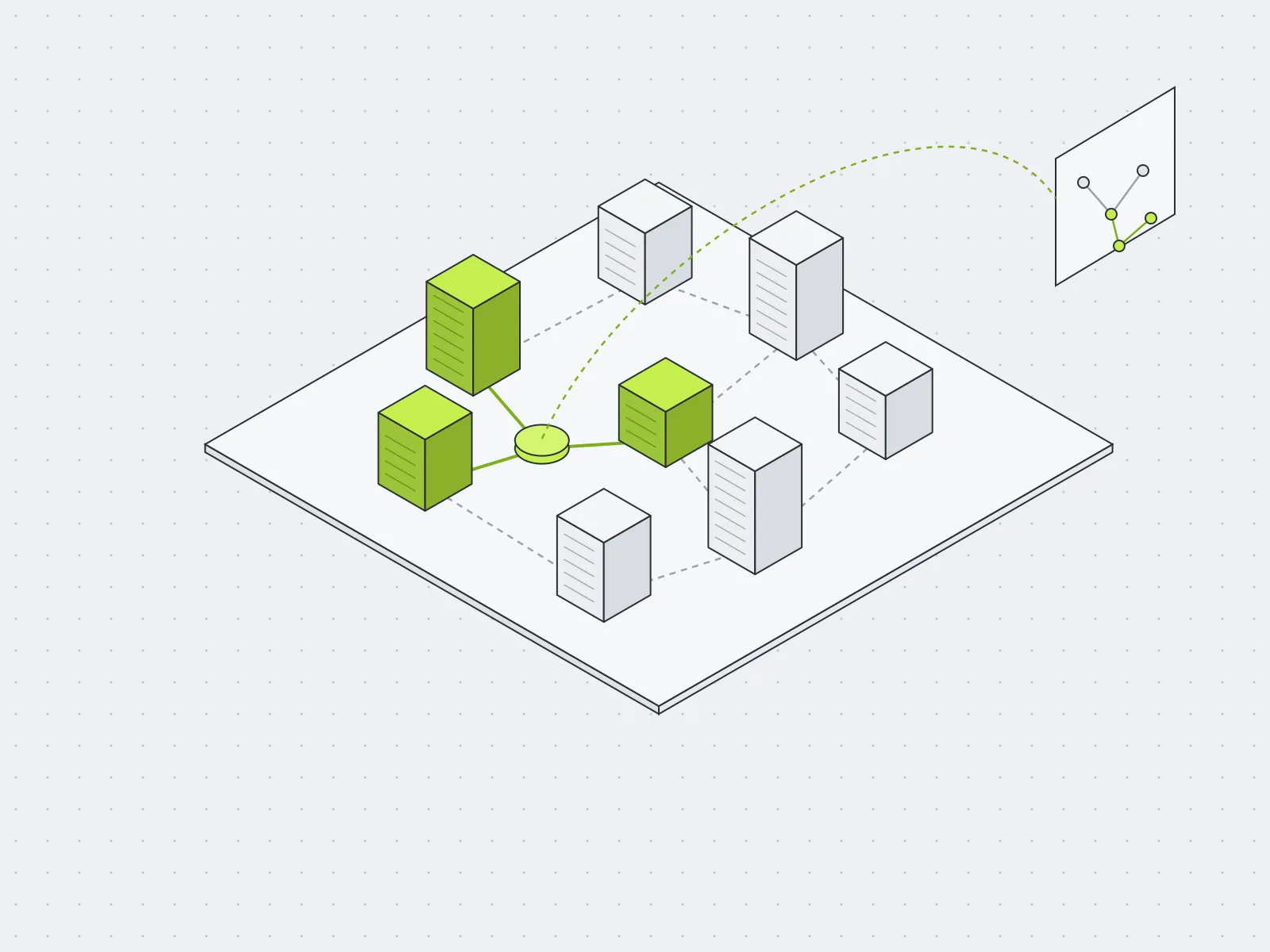
Network analysis joins what firms already report about owners, directors, large exposures and related parties into one map, so supervisors see connected parties and concentrations that no single return shows. In Line4, deterministic rules validate each return as it lands and match the same person or company across firms and filings. The network then shows who is linked to whom and through what, every link points back to the return or register entry behind it, and a supervisor decides what the pattern means.
The problem today
- Each return is checked on its own, so the same borrower or owner behind several firms goes unseen.
- Names, codes and identifiers differ across returns, so matching them is done by hand in spreadsheets.
- Ownership and director data sits in licensing files, apart from the exposure and related-party returns.
How Line4 does it
- 01
Validate, then match
Rules check each return as it lands, then match people and companies across returns by legal entity identifier, registration number and name, with every match shown and open to challenge.
- 02
One map from many returns
Large exposures, related-party lending, shareholder and director data are joined into one network across every firm you supervise.
- 03
Find the pattern
The network highlights groups of connected clients, shared owners and directors, and exposures that cluster on one party, against thresholds your team sets.
- 04
Evidence for the supervisor
Every link points to the return and line it came from. A supervisor reviews the pattern and decides on the next step, and that choice is kept in the evidence trail.
Proven in production
At an international financial regulator
- A prudential submissions portal with real-time validation in production at an international financial regulator: 800+ filings validated.
- Years of AML supervision data at an international financial regulator structured from messy Excel templates by an AI pipeline.
- Regulator-ready analytics and a supervisor chatbot for AML supervision, now live, with answers that link back to the source.
We used to struggle to get anything across the line, and now things are flying through. People are reaching out to us. There’s a lot more trust built here.
Questions
What is network analysis in supervision?
Mapping the links between the firms a supervisor oversees and the people and companies around them: owners, directors, borrowers, counterparties and related parties. Seen as a network, connected groups and concentrations show up that a single return cannot reveal.
Are supervisors already using network analysis?
Yes. ECB Banking Supervision uses a graph tool called Navi when it assesses who owns a bank: “Navi streamlines this process by providing a dynamic view of ownership links and interdependencies, helping supervisors identify potential risks or conflicts of interest early on” (Supervision Newsletter, 14 May 2025). For AML/CFT, the BIS Financial Stability Institute found authorities using network analysis and other tools that “increase their ability to detect networks of related transactions” (FSI Insights No 18, August 2019).
Which returns feed a connected-party network?
Mostly returns firms already file. The Line4 returns library lists more than 50 returns on large exposures, related parties and shareholders from 26 regulators, including COREP large exposures for EU banks, related-party lending at the Central Bank of Ireland, related-party exposures at APRA and large exposures to a connected group at the Central Bank of Kenya. Licensing files add owners and directors.
What is a group of connected clients?
Borrowers that count as one risk because one controls the others or because trouble at one would likely spread to the rest. Banks report exposures to these groups in their large exposures returns, so a supervisor can check that no single group takes too much of a bank’s capital.
How does it help AML/CFT supervision?
Shared owners, directors and addresses across firms are a common sign of hidden control. A network of beneficial owners and directors across the supervised population helps supervisors spot it, and points them to the licensing file or return behind each link.
Who decides what a pattern means?
A supervisor, every time. The network shows links and the evidence behind them. Whether a link matters, and what to ask the firm, stays with a person, and the evidence trail records who decided and on which evidence.
Where does the data live?
Line4 runs in your own cloud tenancy, ideally Azure or AWS, using managed AI services such as Azure AI Foundry or Amazon Bedrock, so your data stays in your own environment. Where cloud is not an option, we can work on premises.
Ready-made checks for the returns you already collect
Our returns library tracks 2,096 returns at 46 regulators in 33 jurisdictions, 665 of them in XBRL, with the format and validation rules for each.
Key terms and guides
More of the platform
- Regulatory data collection
- AML supervision
- Enforcement case management
- Insurance supervision
- Risk-based supervision
- Supervisory analytics
- AI review of regulatory returns
- Early-warning indicators
- Agentic triage of submissions
- Monitoring for unauthorised activity
- SupTech software: the whole platform
- XBRL software for regulators
- What is SupTech?
See network and connected-party analysis in Line4
A demo shows the real screens with sample data. If you want proof on your own data first, run a real filing through Line4 Check, free, with no call and no account.
Our view
RegTech and SupTech are converging on real-time supervision by 2030. Line4 is built for that: checks at the gate in seconds, AI you can audit, and a switch that takes a week.